Equipment platform · YGX2-2 Series
Filling and Capping Monoblock
The YGX2-2 Series combines two filling heads, automatic closure placement and two servo capping heads within one coordinated machine. It is considered when transfers, timing and floor space should be managed as one process.
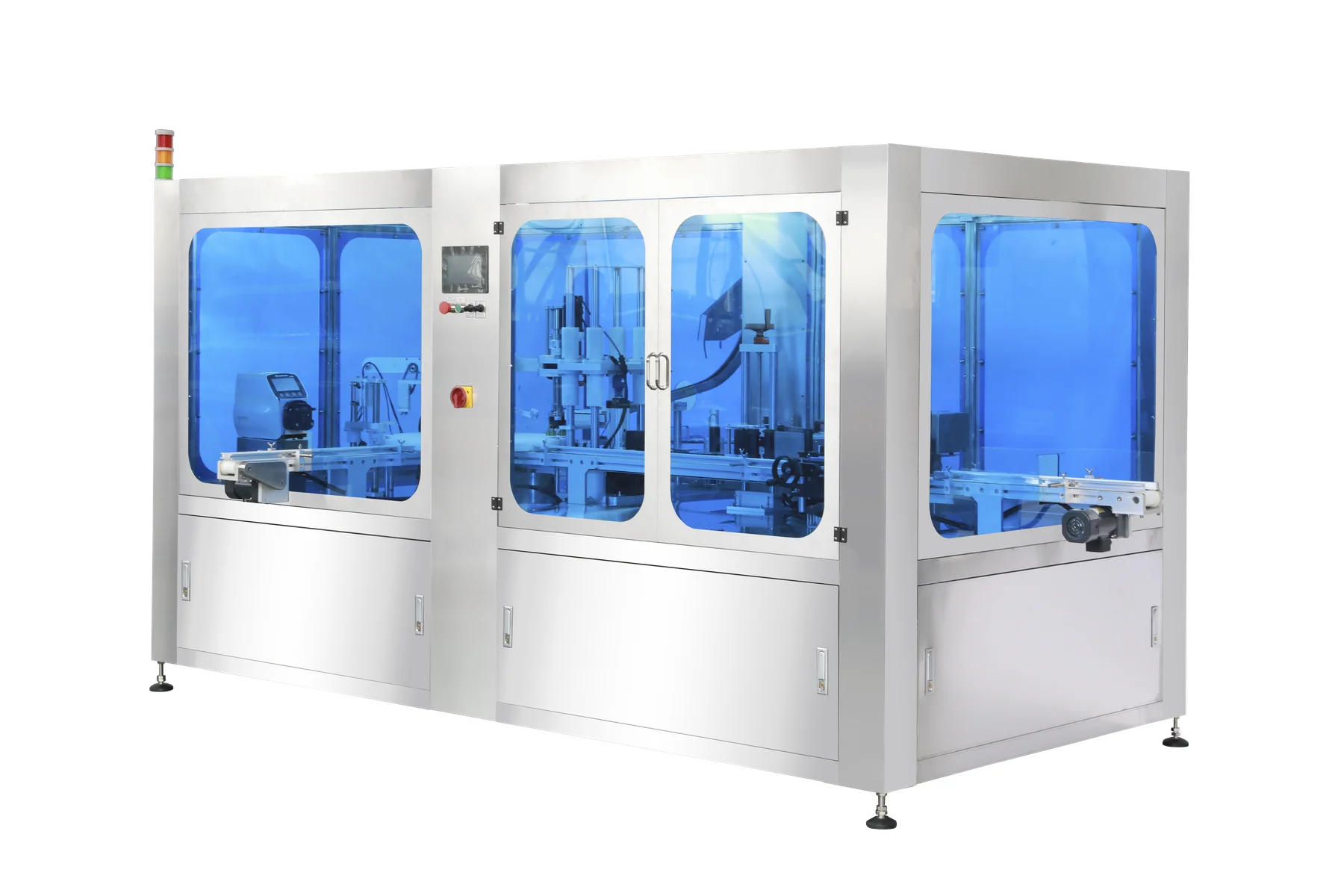
Small-dose, pumpable liquids in stable bottles with automatically fed closures, subject to dose, pump, bottle and cap confirmation
Indexed bottle handling coordinates filling, cap placement and servo capping within one compact platform while each product and closure remains project-specific.
Selection boundary
When this architecture fits—and when it needs another review.
Evaluate this platform when
- Small-format bottle projects that benefit from one coordinated filling and capping platform
- Pumpable liquids compatible with the confirmed dosing system and product-contact tubing
- Closures that can be oriented, placed and tightened with the selected feeder and capping heads
- Lines where indexed bottle control can connect to upstream infeed and downstream labeling or inspection
Do not select from the page alone when
- Products or doses that have not been checked against the selected pump and tubing
- Bottles or closures supplied without controlled drawings and representative samples
- Sterile, aseptic or regulated applications whose validation and compliance scope has not been separately defined
- Projects expecting published speed, accuracy or cap-acceptance guarantees without agreed test conditions
Working principle
How the machine moves product and containers through the process.
- 01
Index the bottles
The conveyor and indexing mechanism separate and position bottles for the filling station.
- 02
Fill the programmed dose
The documented configuration uses two peristaltic-pump filling heads; the final pump and tubing are confirmed for the liquid and dose.
- 03
Feed and place closures
A closure feeder organizes caps and presents them for automatic placement on the filled bottles.
- 04
Apply controlled capping
Two servo-controlled capping heads complete the closing action according to the confirmed bottle, cap and acceptance criteria.
- 05
Transfer for inspection or labeling
Closed bottles leave the monoblock for the agreed downstream inspection, labeling or collection process.
Documented configuration
Publishable model and range information.
These are source-backed configuration references. Output, accuracy, utilities, dimensions and acceptance criteria are confirmed for the actual product and project.
| Model | Filling heads | Capping heads | Documented fill range | Evidence boundary |
|---|---|---|---|---|
| YGX2-2 documented configuration | 2 | 2 | 10–100 mL | The documented range is a configuration reference, not a universal series guarantee. Final suitability depends on the liquid, pump, tubing, dose, bottle and closure. |
Verified operating facts
What is documented—and what it means in production.
Station arrangement
2 filling + 2 capping headsThe source title, process description and parameter table support this arrangement.
Filling method
Peristaltic-pump configurationPump, tubing and dose settings remain product-specific.
Closure handling
Automatic feeding, placement and servo cappingFeeder tooling and capping heads are selected from cap drawings and samples.
Bottle control
Indexed positioning with photoelectric detectionNo-bottle/no-fill and no-bottle/no-cap logic is included in the documented operating sequence.
Documented features
Features connected to operation and maintenance.
Final performance, materials, utilities and acceptance criteria depend on the confirmed product and technical agreement.
- Two filling and two capping heads
- Indexed bottle positioning
- Documented peristaltic-pump filling configuration
- Automatic cap feeding and placement
- Servo-controlled capping
- No-bottle/no-fill and no-bottle/no-cap detection
Daily operation
Plan changeover, cleaning and line interfaces before quotation.
Changeover
Bottle indexing parts, cap feeder tooling, capping heads, pump tubing and recipes may change between formats. The format matrix should be reviewed before the scope is fixed.
Cleaning
The cleaning approach depends on the selected pump, tubing, filling nozzles and product-change requirements; it is not inferred from the monoblock layout alone.
Line integration
Bottle infeed, closure replenishment, inspection, labeling and collection interfaces should be confirmed as one operating sequence.
Selection inputs
Information needed for configuration.
- Liquid properties, dose and tubing compatibility
- Bottle drawing, stability and sample quantity
- Cap drawing, orientation and physical samples
- Required closing action and acceptance criteria
- Target output and inspection scope
- Cleaning, changeover and line-interface requirements
Buyer questions
Questions to resolve before equipment selection.
The answers describe the current evidence boundary and the information required for a project-specific proposal.
Is YGX2-2 only for pharmaceutical or IVD products?
No. The architecture can be assessed for other pumpable small-dose liquids when the product, bottle, closure and cleaning requirements are suitable.
Is the filling pump always peristaltic?
The documented configuration uses peristaltic pumps. The final dosing method and tubing must be confirmed for the product and dose rather than assumed from the series name.
Can it run several bottle and cap formats?
It can be evaluated through a format matrix. Each bottle and closure combination may require change parts, feeder tooling, capping heads and separate settings.
What information is needed for a proposal?
Provide liquid and dose details, bottle and cap drawings and samples, target output, closing criteria, cleaning method, inspection scope, utilities and available floor space.
Related planning content
Connect the machine to the application and line requirement.
Project requirement checklist
Liquid supplement line checklist
A useful proposal starts with the formula, dose, bottle, closure, hygiene approach, inspection scope and production target. This checklist helps a project team organize those inputs before equipment selection.
Read the guide →
Packaging sample checklist
Bottle and cap information checklist
Bottle and closure details affect filling position, conveying, cap feeding, tightening, labeling and changeover. Supplying drawings and representative samples early reduces avoidable assumptions in a line proposal.
Read the guide →The public page states only the documented 2+2 arrangement, operating sequence and conditional 10–100 mL configuration. Conflicting accuracy, speed, acceptance-rate, material and compliance claims are excluded.
Start with the production task
Share the product, pack and output you need to run.
Prepare your material, container, closure, label, target output and available floor space. These inputs define the right next step.
Prepare your project brief →